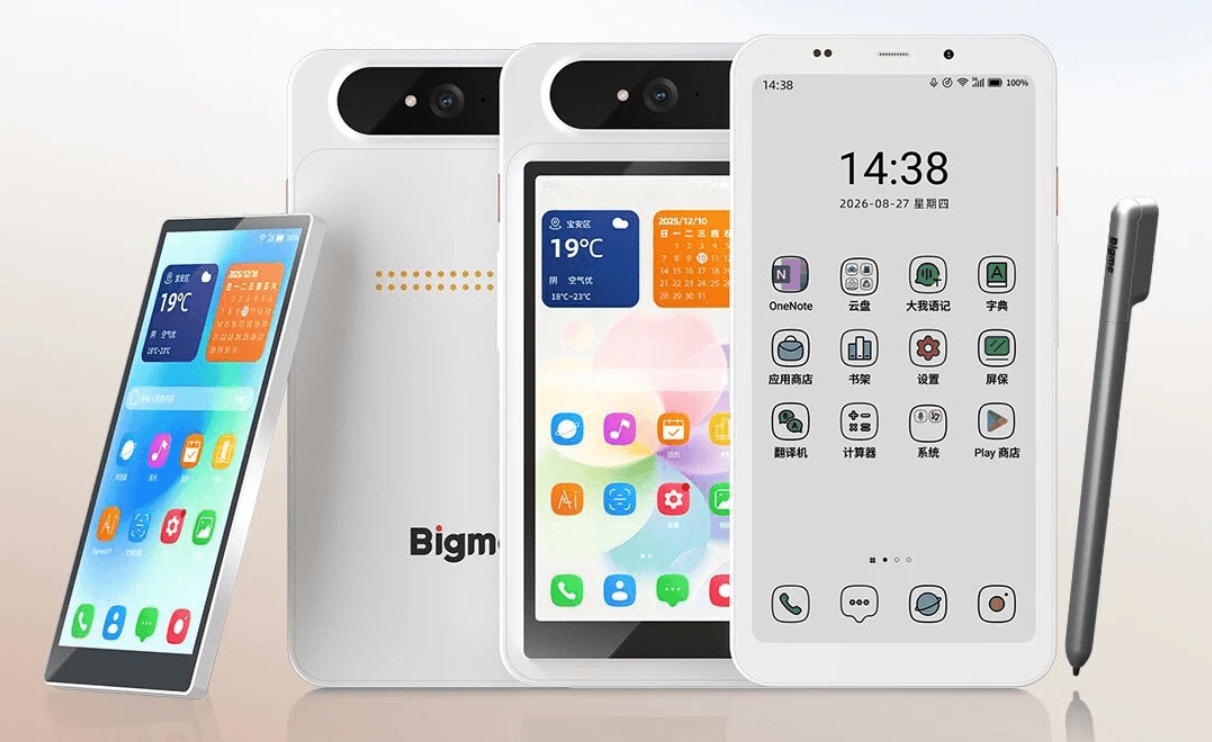
Bigme has announced the HiBreak Dual 3, its latest E Ink smartphone offering and the newest entry in a lineup the company has been building for several years. However, the company has adopted a different approach to its concept of a dual-screen phone this time. The new HiBreak Dual 3 now features a detachable color LCD screen that attaches to the back of the phone, giving users a full-color display option, but only when they actually want one.
That’s a meaningful change from the HiBreak Dual 2, which launched on Kickstarter roughly two months earlier with a fixed 5-inch LCD that couldn’t be removed. The Dual 3 keeps a color E Ink display as the primary screen but swaps that permanent secondary panel for a magnetic LCD module that snaps on and off as needed.
Bigme unveiled the HiBreak Dual 3 in late August 2026, but the announcement leaves several details open. The company is yet to reveal several key aspects of the phone, which include a firm release date, screen dimensions, and battery capacity, only choosing to state the phone is “coming soon”.
What Is the Bigme HiBreak Dual 3?
The HiBreak Dual 3 is an Android smartphone built around a color E Ink display as its primary screen, paired with a secondary color LCD panel that connects magnetically to the back via metal contact pins for power and data. Unlike a typical dual-screen phone with two permanently attached displays, this module is meant to be attached and removed as needed.
Confirmed details include a MediaTek Dimensity 8300 processor, Android 16, 5G with dual-SIM dual-standby support, a 4096-level pressure-sensitive stylus, and an E Ink refresh rate of up to 85Hz. The detachable secondary display is the single biggest change from its predecessor, and the detail that should anchor how this phone gets evaluated.
The Detachable LCD Is the HiBreak Dual 3’s Big Idea
E Ink Is Great Until You Need a Conventional Display
E Ink handles reading, web browsing, messaging, writing, and other largely static interfaces extremely well. It’s easy on the eyes, perfectly readable in sunlight, and sips very little power. But it remains a poor fit for video, fast-scrolling social feeds, games, and anything built around rapid, colorful transitions, which is exactly what most Android apps assume a phone will display.
Instead of Compromising, Bigme Adds Another Screen
Rather than trying to make E Ink behave like a conventional display, or accepting a permanent second screen the way the Dual 2 did, Bigme is letting users decide when they need each one. The pitch is straightforward: use E Ink when E Ink makes sense, and snap on the LCD when it doesn’t.
Bigme HiBreak Dual 3 Specifications
| Feature | HiBreak Dual 3 |
|---|---|
| Product type | E Ink smartphone |
| Main display | Color E Ink |
| Secondary display | Detachable color LCD, magnetic attachment |
| E Ink refresh rate | Up to 85Hz |
| Processor | MediaTek Dimensity 8300 |
| Operating system | Android 16 |
| Cellular | 5G |
| SIM | Dual SIM, dual standby |
| RAM | 12 GB or 16 GB |
| Storage | 256 GB or 512 GB |
| Stylus | 4096 levels of pressure sensitivity |
| Rear camera design | Redesigned, vertical pill-shaped module |
| Battery | Not yet announced |
| Screen dimensions | Not yet announced |
| Price | Not yet announced |
| Release date | Not yet announced |
The 85Hz refresh rate, Dimensity 8300 chip, Android 16, 5G dual-SIM support, both memory configurations, and the 4096-level stylus are all confirmed. Screen sizes, resolutions, battery capacity, and full dimensions are not. Worth noting: the Dual 2 came in both color and black-and-white E Ink versions, but coverage of the Dual 3 so far only mentions color, so a monochrome variant isn’t confirmed either way.
Specs from the Dual 2 shouldn’t be assumed to carry over automatically — the 5-inch, 1280×720 LCD on the Dual 2, for instance, has no confirmed equivalent for the Dual 3’s detachable module.
An 85Hz E Ink Display, Up From 80Hz on the Dual 2
E Ink traditionally struggles with fast movement because its particles physically shift position with each screen update, slower than switching pixels on an LCD or OLED panel. A higher refresh rate is meant to make scrolling, typing, and app switching feel less sluggish.
That’s a real improvement over the 80Hz Bigme quoted for the Dual 2. But 85Hz doesn’t make E Ink behave like an 85Hz LCD or OLED panel. It says something about how fast the screen can update, not about ghosting, color rendering, or how responsive the interface will actually feel, and those questions won’t be answered until the phone is out in the wild.
Dimensity 8300 and Android 16 Give It Real Smartphone Hardware
The Dimensity 8300, carried over unchanged from the Dual 2, is more powerful than the hardware typically found in niche E Ink devices. Paired with full Android 16, the HiBreak Dual 3 isn’t positioned as a stripped-down reading gadget; it’s an Android smartphone that happens to lead with E Ink.
Bigme hasn’t separately confirmed Google Play availability for the Dual 3. The Dual 2 supported Play Store access, but that shouldn’t be assumed to carry over without direct confirmation.
Up to 16 GB of RAM and 512 GB of Storage
Bigme is offering the HiBreak Dual 3 in the same two configurations the Dual 2 launched with: 12 GB/256 GB and 16 GB/512 GB. The lower tier suits reading, messaging, and general productivity; the higher tier gives heavier multitaskers more headroom.
It’s worth asking whether an E Ink phone actually needs this much memory. The honest answer: the RAM isn’t really about E Ink at all — it’s about running a full Android app ecosystem smoothly, which is quite different than powering an e-reader.
The HiBreak Dual 3 Supports a Pressure-Sensitive Stylus
Bigme has confirmed 4096 levels of pressure sensitivity, which should be enough for tasks like jotting down quick notes, annotation, signatures, and sketching on the E Ink display. The company hasn’t detailed the software side yet, which means there is no confirmation if features like palm rejection, latency, or any bundled note-taking app are going to be available.
Bigme HiBreak Dual 3 vs. HiBreak Dual 2
| Feature | HiBreak Dual 2 | HiBreak Dual 3 |
|---|---|---|
| Main E Ink display | 6.13″, color or black-and-white | Color, size unconfirmed |
| Secondary display | Fixed 5″ LCD, 1280×720 | Detachable LCD, size unconfirmed |
| E Ink refresh | 80Hz | 85Hz |
| Processor | Dimensity 8300 | Dimensity 8300 |
| Android version | Android 16 | Android 16 |
| RAM / storage | 12 GB/256 GB or 16 GB/512 GB | 12 GB/256 GB or 16 GB/512 GB |
| Stylus | Yes | Yes, 4096 pressure levels |
| 5G / dual SIM | Yes | Yes |
| Secondary display removable | No | Yes |
| Rear camera design | Standard | Redesigned, pill-shaped |
| Price | $599 Kickstarter early bird | Not yet announced |
| Release | Launched via Kickstarter, July 2026 | Coming soon, no firm date |
The memory and storage aren’t actually an upgrade here since Bigme offered both tiers on the Dual 2 too. The real story of this generation isn’t a spec bump; it’s the shift from a fixed second screen to a modular one.
Why Is Bigme Making the LCD Screen Detachable?
A few reasons make sense together. E Ink remains the better display for reading and text-heavy work; a conventional panel remains better for video, games, and color-heavy content; and most people don’t need that color screen attached all day. Making it removable hands users more control over how the phone is configured, and results in a genuinely different experience than either a single-screen E Ink phone or a permanently dual-screen one.
The Biggest Advantages of the Bigme HiBreak Dual 3
- An E Ink-first experience built around long-form reading
- A conventional display available on demand, not built in
- Full Android 16 with access to the broader app ecosystem
- A higher-refresh E Ink panel, up from the Dual 2’s 80Hz
- Stylus support with 4096 pressure levels
- Generous memory configurations up to 16 GB/512 GB
- 5G connectivity with dual-SIM support
The Biggest Questions and Potential Drawbacks
The detachable screen could be awkward in practice. Where do you carry the LCD module when it’s off the phone? How securely does it attach, and does it add bulk when both pieces are together? None of this is answerable until the phone ships.
Two screens mean two things that can go wrong. A magnetic, pin-based connection introduces more potential failure points than a single fixed display.
85Hz is still E Ink. The higher number doesn’t erase the underlying differences between electrophoretic displays and emissive ones.
Color E Ink has real limits. Colors look more muted than on LCD or OLED, color resolution is lower than monochrome mode, and transitions are slower. It is fine for reading and browsing but not quite so for video or games, which is exactly why the detachable LCD exists.
Android apps assume a conventional display. Most software isn’t designed around E Ink’s refresh limitations, which happens to be a persistent challenge for every E Ink phone so far.
The price is unknown. Until Bigme names a number, there’s no way to know whether the concept feels worth the trade-offs.
When Will the Bigme HiBreak Dual 3 Be Released?
Bigme says the HiBreak Dual 3 is coming “soon” but hasn’t given a firm date. We’ll update this section once Bigme announces launch details.
How Much Will the Bigme HiBreak Dual 3 Cost?
Yet to be announced. Given how unusual this form factor is, price will likely be one of the biggest factors in whether it finds an audience beyond the E Ink enthusiast crowd, but there isn’t enough information yet to estimate a number.
The Bigme HiBreak Dual 3 isn’t the only recent device pushing E Ink toward the form factor of a smartphone. PocketBook’s Q takes a different approach, focusing on phone-sized E Ink reading rather than building a conventional smartphone around the display.
Bigme HiBreak Dual 3 vs. PocketBook Q
| HiBreak Dual 3 | PocketBook Q | |
|---|---|---|
| Core identity | E Ink smartphone | E Ink reading device |
| Primary purpose | Smartphone plus reading | Reading and audiobooks |
| Platform | Android 16 | Linux-based, no app store |
| Cellular | 5G, dual-SIM | None (Wi-Fi and Bluetooth only) |
| Main display | Color E Ink, up to 85Hz | 5.84″ E Ink Carta 1300, black-and-white |
| Conventional display | Detachable color LCD | None |
| Price | Not yet announced | $235 / €199 / £175 |
| Availability | Coming soon | Preorders around IFA 2026, ships this fall |
PocketBook Q takes phone-sized E Ink in the opposite direction from the HiBreak Dual 3. PocketBook is asking how small and distraction-free an E Ink reader can become; Bigme is asking how much of a full smartphone can be built around E Ink. Different questions, not competing answers to the same one.
Bigme and the Rise of the E Ink Smartphone
The HiBreak Dual 3 is the latest addition in a lineup that includes the original HiBreak, HiBreak Pro, HiBreak Color, HiBreak Plus, HiBreak Dual, and HiBreak Dual 2, and the pace has picked up noticeably — the Dual 3 arrived roughly two months after the Dual 2 hit Kickstarter.
Bigme isn’t alone in exploring detachable color displays. Hisense’s A10 pairs a 6.13-inch E Ink front panel with a magnetically detachable color LCD, an approach similar in spirit to the Dual 3. That makes Bigme’s announcement part of a broader shift: several manufacturers are now treating E Ink as a viable primary smartphone display, with a conventional screen available as an add-on rather than the default.
Is the Bigme HiBreak Dual 3 the Future of E Ink Smartphones?
There’s a real case for this approach: an E Ink-first phone reduces visual distraction for reading-heavy use, a detachable LCD removes the compromise of carrying a screen you don’t always need, and full Android 16 on capable hardware means it isn’t limited to a narrow set of reading apps.
There’s also a real case against it: the hardware could be awkward in daily use, the price is unknown, Android software still isn’t built around E Ink’s limitations, and it’s not obvious how many people want to carry a second display module at all.
The HiBreak Dual 3 probably isn’t a preview of where smartphones in general are headed. But it might point to something narrower and still interesting: instead of forcing E Ink to act like OLED, manufacturers can let each display do the job it’s actually good at.
Bigme HiBreak Dual 3 FAQ
What is the Bigme HiBreak Dual 3? An Android smartphone with a color E Ink primary display and a detachable color LCD that attaches magnetically to the back.
Is the Bigme HiBreak Dual 3 an E Ink smartphone? Yes, with a secondary conventional display available as a removable add-on.
Does the HiBreak Dual 3 have a detachable LCD? Yes — unlike the Dual 2’s fixed 5-inch LCD, this one attaches and detaches magnetically.
What processor does the HiBreak Dual 3 use? A MediaTek Dimensity 8300, the same chip as the Dual 2.
What version of Android does the HiBreak Dual 3 run? Android 16.
How fast is the HiBreak Dual 3’s E Ink display? Up to 85Hz, up from 80Hz on the Dual 2.
How much RAM and storage does the HiBreak Dual 3 have? 12GB/256GB or 16GB/512GB, depending on configuration.
Does the HiBreak Dual 3 support a stylus? Yes, with 4096 levels of pressure sensitivity.
Does the HiBreak Dual 3 support 5G? Yes, with dual-SIM dual-standby support.
When will the HiBreak Dual 3 be released, and how much will it cost? Neither has been announced. Bigme says only that the phone is coming soon.