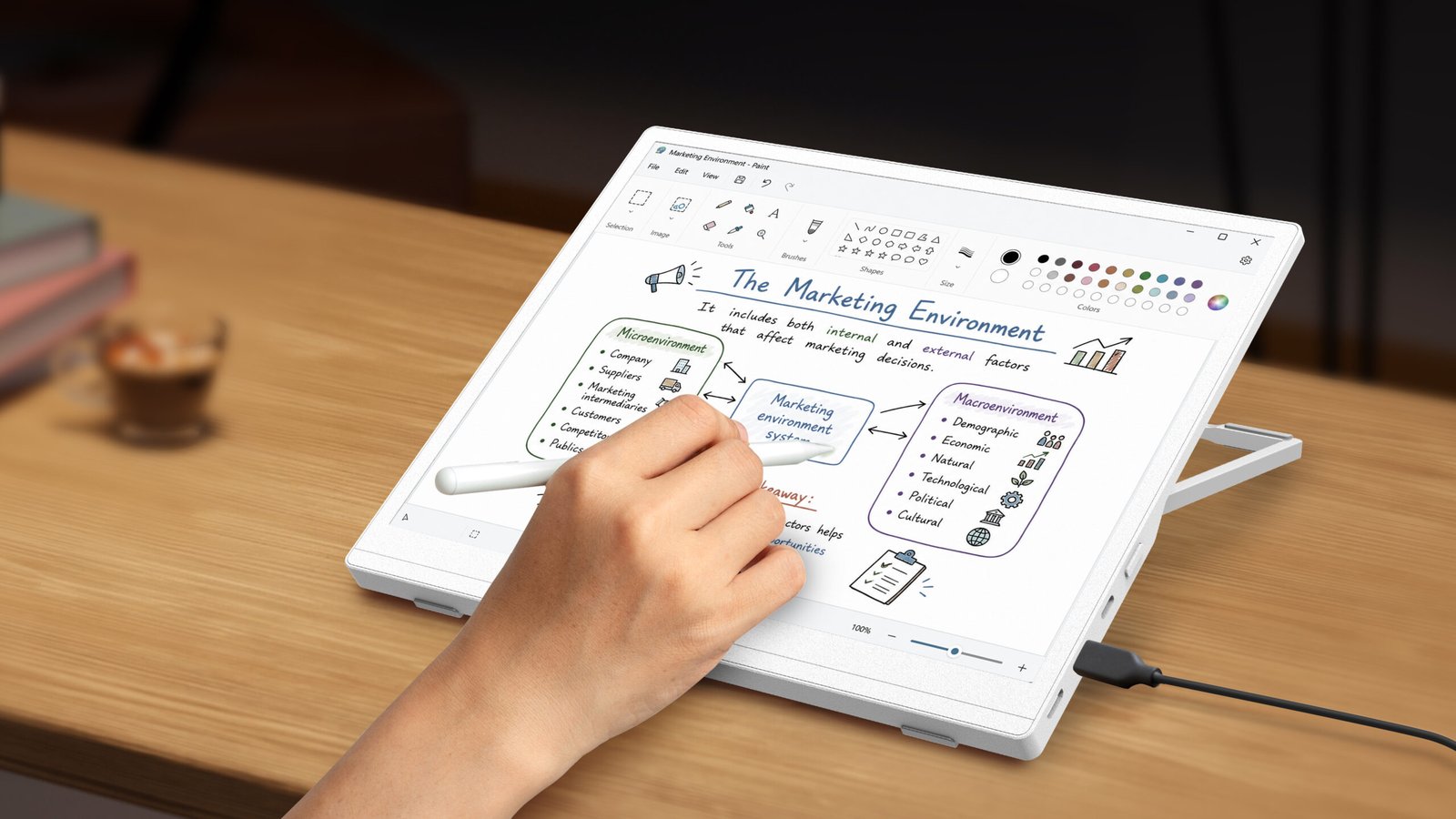
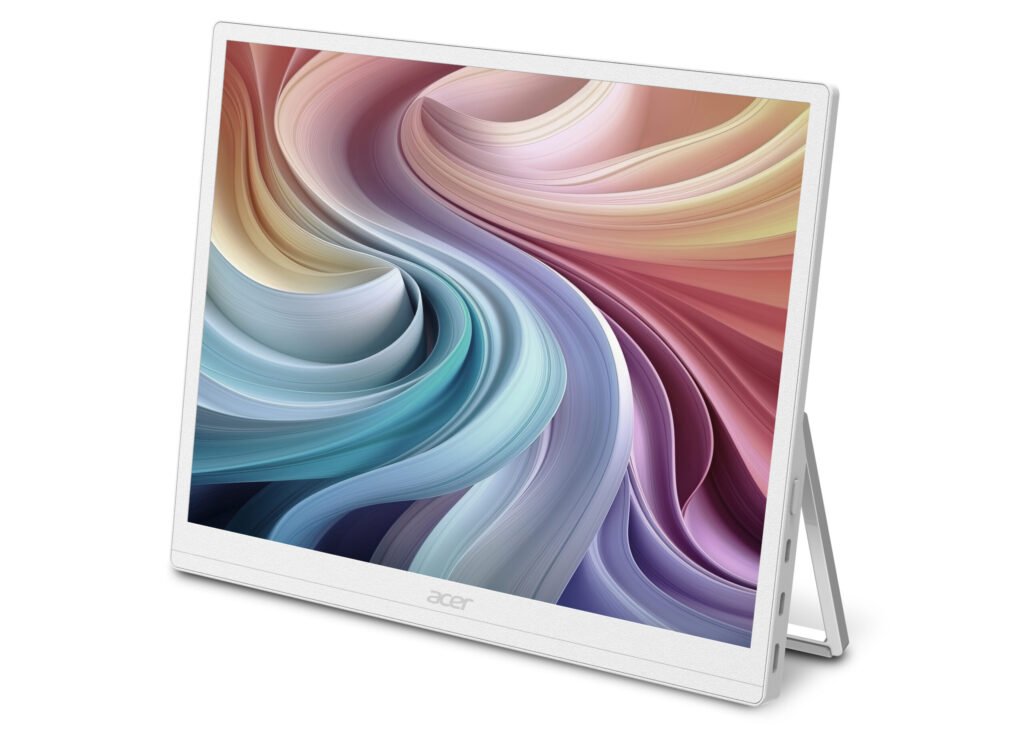
Acer unveiled the EP130K portable e-paper monitor at the IFA 2026 event currently underway in Berlin. The EP130K is a portable e-paper monitor with touch support, color and black-and-white modes, and a refresh rate of up to 60Hz. The announcement is significant considering that this marks the first time Acer – a mainstream PC and monitor brand – has forayed into the e-paper display segment.
The headline numbers are straightforward. The EP130K is a 13.3-inch touch capable E Ink display of up to 3,200 x 2,400 resolution in black-and-white mode, with a separate color mode, a 60Hz refresh rate, and a portable, USB-C-powered design. Acer has not yet said exactly when the monitor will reach store shelves, only that it’s coming in early 2027.
Acer EP130K: What exactly has Acer launched?
The EP130K is a portable secondary monitor built around a reflective e-paper panel rather than the LCD or OLED panels found in most portable monitors, including Acer’s own PD163Q P3 triple-screen extender announced alongside it. It’s designed to complement a laptop or tablet and plug in over USB-C, and not to replace a primary desktop display.
Acer says the monitor is intended for professionals doing extended document-based work, avid readers, students and researchers, and people who work outdoors or in bright ambient light. Those are Acer’s stated target users, and it remains to be seen how the EP130K performs for each of them in real life.
Acer EP130K specifications
The table below reflects the specifications Acer published in its official IFA 2026 announcement. Some key aspects of the monitor, such as the underlying panel technology, haven’t been revealed, leaving room for speculation.
| Specification | Acer EP130K |
|---|---|
| Display size | 13.3 inches |
| Display type | e-paper |
| Surface | Matte |
| B&W resolution/refresh | 3,200 x 2,400 @ 60Hz |
| Color resolution/refresh | 1,600 x 1,200 @ 60Hz |
| Colors | Up to 4,096 |
| Response time | 20ms (gray-to-gray), per Acer |
| Touch | Yes, finger and stylus |
| Viewing angle | 178° horizontal, 178° vertical |
| Connectivity | 1x mini-HDMI, 2x USB-C, speaker output, audio out |
| Speakers | Dual 1W |
| Stand | Integrated, tilts 0°–180° |
| Power | USB Type-C (12V/1.25A or 5V/3A) |
| Price | $749.99 (US), €749 (EMEA), AUD 1,499 (Australia) |
| Availability | Q1 2027 in North America, EMEA, and Australia |
Though not officially confirmed, it is likely that the panel is an E Ink Kaleido 3 display, which would be consistent with the confirmed 4,096-color figure. Acer also hasn’t disclosed the monitor’s weight, dimensions, or the processor driving it.
The 60Hz refresh rate is the specification that stands out
e-Paper has historically struggled with refresh speed. Older monochrome and color e-paper panels update slowly enough that fast-moving content, and sometimes even ordinary cursor movement, appears sluggish or leaves visible ghosting behind. That’s part of why e-paper monitors have stayed a niche product: they’re fine for reading static pages but frustrating for everyday desktop use, where the cursor and scroll wheel are in near-constant motion.
A 60Hz refresh rate, if it holds up in practice, could meaningfully improve cursor tracking, scrolling, window switching, and general responsiveness compared with older e-paper displays. Acer also lists a 20ms gray-to-gray response time for the EP130K, which is fast by e-paper standards, though still an order of magnitude slower than a typical LCD or OLED panel.
It’s worth being precise about what “60Hz” means here. It describes how often the panel can update, not how it behaves when it does. e-Paper panels manage refresh speed, ghosting, and image quality as competing trade-offs, and manufacturers can tune a panel’s driving mode to favor one over the others. A 60Hz spec doesn’t guarantee the EP130K will feel like a 60Hz LCD monitor for tasks like video playback or fast-scrolling web pages, and Acer hasn’t claimed that it does. Whether the panel actually delivers clean motion at that refresh rate, or introduces new ghosting and latency trade-offs to hit it, is something only hands-on testing will settle.
One monitor, two very different display modes
The EP130K’s two modes aren’t just a color toggle; they come with different resolutions. Black-and-white mode reaches the full 3,200 x 2,400 pixels; switching to color drops that to 1,600 x 1,200, with a maximum of 4,096 colors on screen at once.
Color e-paper panels are also known for looking somewhat muted and lower-contrast than emissive displays, since the color layer sits over a grayscale panel and absorbs some of the light that would otherwise bounce back to the viewer. In practical terms, the color mode is likely better suited to charts, diagrams, highlighted text, and simple web pages than to color-critical photo or video work, though Acer hasn’t published color-accuracy figures yet.
Why use e-Paper as a computer monitor?
The case for an e-paper monitor rests on how the panel reflects light rather than emits it. Without a backlight, the EP130K should be easy to read in direct sunlight or under strong indoor lighting — conditions that wash out conventional monitors — and its matte surface is designed to avoid glare.
The panel is also bi-stable, a feature typical of E Ink displays. Once it draws an image, it can hold that image on screen without continuing to draw power. That makes static content, like a reference document or a spreadsheet left open in the background, essentially free to display. It’s a genuinely different power profile from an LCD or OLED screen, which needs constant power to keep any image on screen at all.
Touch and stylus support make it more than a passive second screen
Acer built touch directly into the EP130K’s panel, and the company says it responds to both a finger and a stylus. That opens up use cases beyond simply mirroring a laptop screen as users can perform tasks such as annotating a PDF, navigating a long document, or sketching a quick diagram directly on the display.
Acer hasn’t detailed which stylus protocol the EP130K supports, whether it offers pressure sensitivity or tilt detection, whether palm rejection is built in, or whether a stylus is included in the box. Those are the details that would determine how well the monitor actually works for handwriting or drawing, and none of them are public yet.
Connectivity and portable design
The EP130K connects over one mini-HDMI port and two USB-C ports, one of which can carry both video and power from a connected laptop or tablet. That means a single cable can be enough to run the display. It ships with an integrated stand that tilts from 0 to 180 degrees There is also a pair of 1W speakers included, plus a separate audio-out jack.
None of that is unusual for a portable monitor. What it does confirm is that Acer is positioning the EP130K as something to travel with and set up temporarily, rather than a fixture on a permanent desk setup — closer in spirit to a lightweight companion display than to a standard external monitor.
Acer isn’t alone: e-Paper monitors are becoming more serious
Smaller manufacturers like Dasung and Bigme have sold e-paper monitors for years, largely without breaking into the mainstream. Acer’s entry, alongside a similar move from Asus, suggests bigger PC brands now see enough demand to try.
Asus showed its own 13.3-inch color e-paper monitor, the ZenScreen Color ePaper MP13UC, at Computex 2026. It shares the EP130K’s 13.3-inch size, 3,200 x 2,400 black-and-white resolution, and 4,096-color palette, but its refresh rate tops out at 35Hz against the EP130K’s 60Hz. Asus had not announced pricing or a firm release date for the MP13UC as of publication. .
What Acer still hasn’t told us
Several practical questions remain open:
- Exact retail availability dates within Q1 2027
- The EP130K’s weight and dimensions
- Real-world ghosting, latency, and cursor behavior at 60Hz
- Stylus protocol, pressure sensitivity, and whether a pen is included
- Which processor drives the display
- Power consumption in active use versus standby
- Compatibility details with specific laptops, tablets, or operating systems
Price and availability
Acer has confirmed pricing: $749.99 in the US, €749 across EMEA, and AUD 1,499 in Australia, with availability in all three regions set for the first quarter of 2027.
Why the Acer EP130K matters
The bigger story isn’t that another e-paper monitor has broken onto the scene, but that a major, mainstream PC manufacturer is willing to put its name on a 13.3-inch, touch-enabled, color e-paper monitor rated for 60Hz. Refresh performance has long been one of the clearest reasons e-paper hasn’t caught on for everyday computer work, and Acer’s spec sheet suggests it’s taking that problem seriously.
Specifications alone can’t confirm whether Acer has actually solved e-paper’s traditional issues with ghosting, latency, and motion handling — only hands-on use can. Whether the EP130K becomes a genuinely useful productivity display, or another interesting-on-paper alternative to conventional portable monitors, will come down to two things nobody can evaluate yet: how it performs in real use, and how its final price compares with what it delivers.